How Earthquakes Happen
Earthquakes occur because the Earth’s outer shell — the crust — is not one solid piece. Instead, it is broken into massive slabs called tectonic plates that slowly shift over the planet’s softer, hotter inner layer.
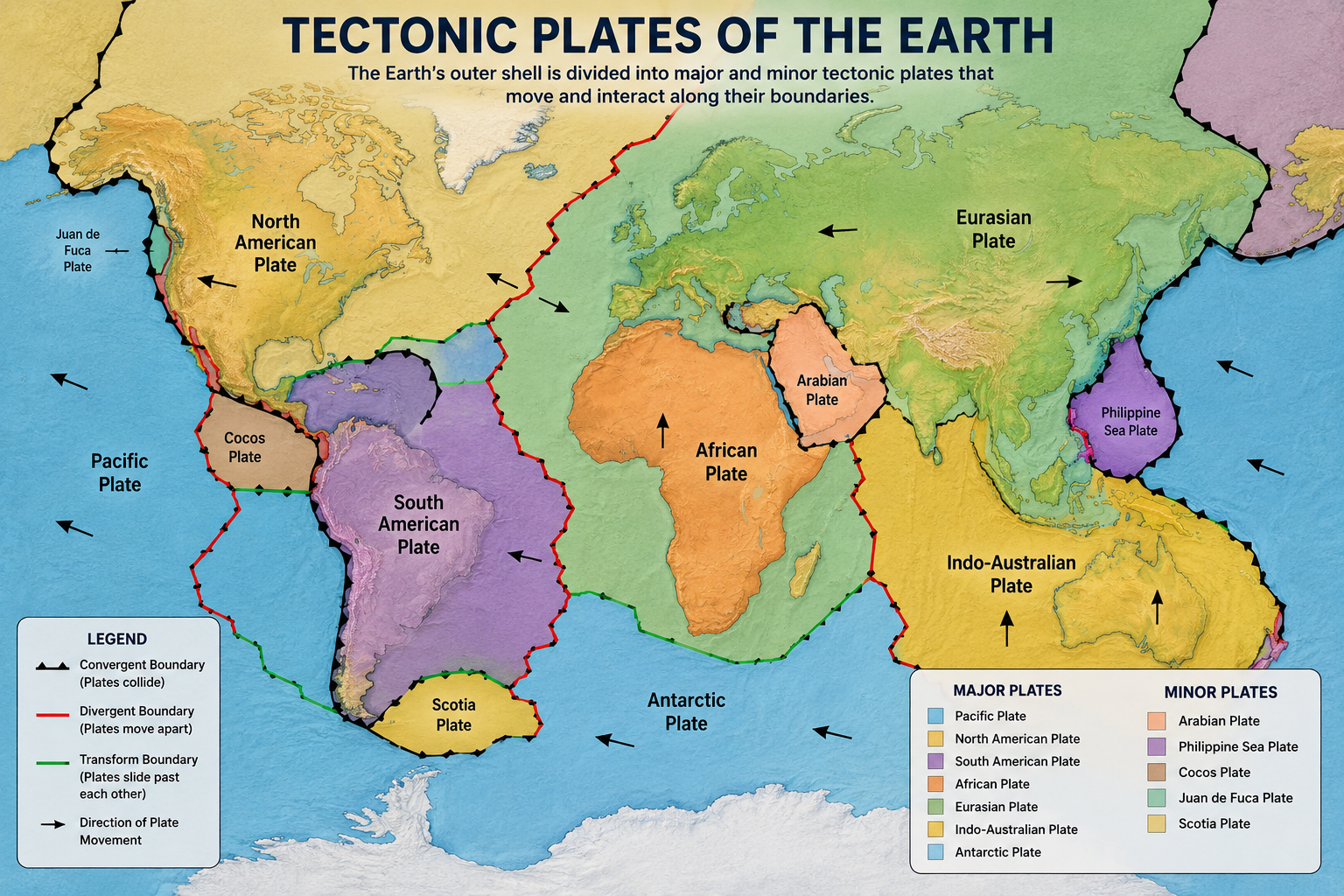
Here is how the process works:
- Plates move and lock together: These plates drift very slowly — roughly as fast as your fingernails grow. Where they meet, they may push against each other, pull apart, or slide side-by-side. Friction often holds their edges firmly in place, so they do not glide smoothly.
- Pressure builds up: Even though the edges are stuck, the rest of the plate keeps moving. This stores up enormous amounts of energy and tension in the rock, just like bending a stick further and further until it cannot bend anymore.
- Energy is released: When the stress becomes too great, the rock suddenly cracks or slips. All that stored energy bursts out in the form of seismic waves, which travel outward through the Earth.
- The ground shakes: When these waves reach the surface, they make the ground vibrate, sway, or shift — this is what we experience as an earthquake.
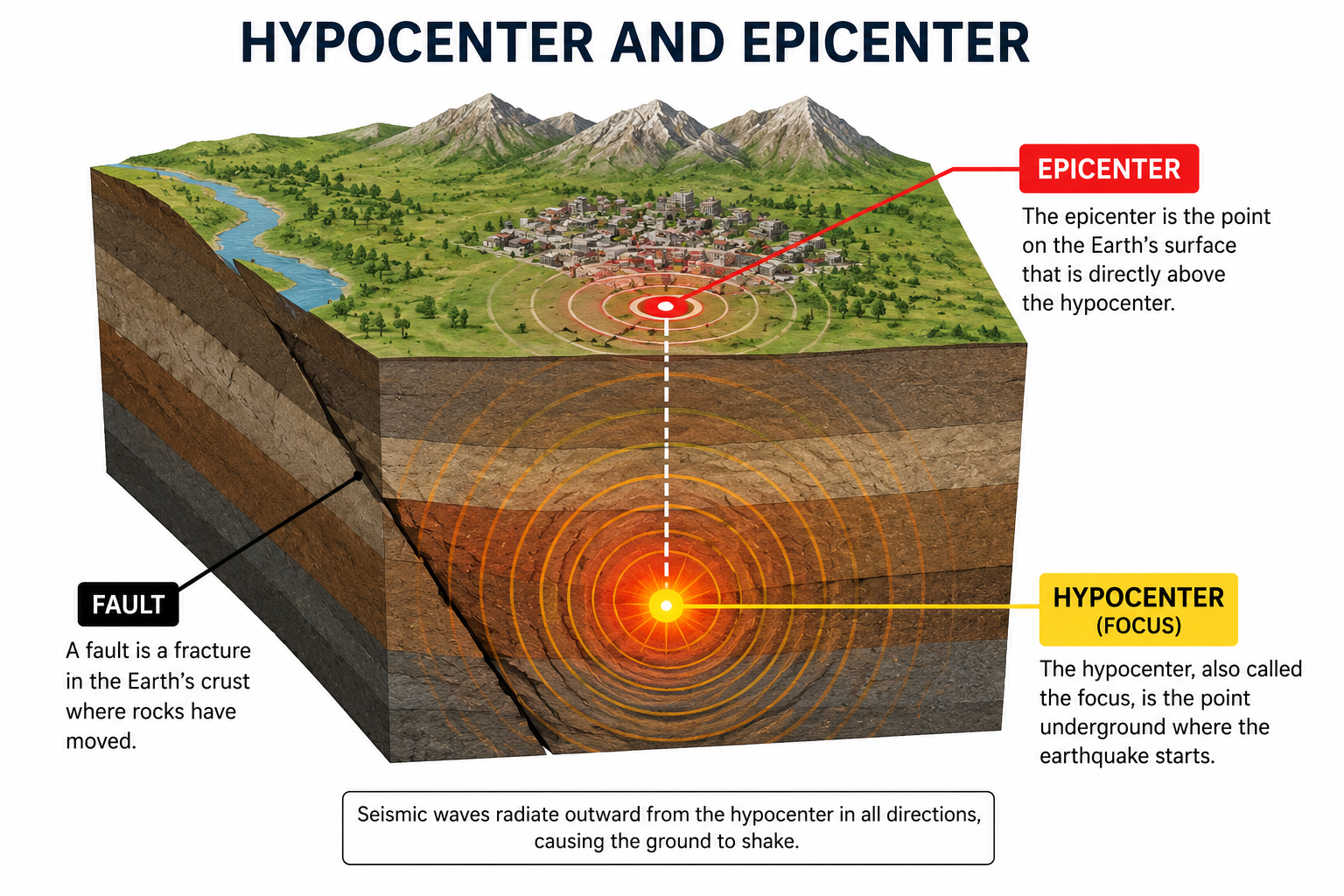
The location underground where the rock first breaks is called the hypocenter. The point directly above it on the surface is the epicenter.
Key terms
- Focus (Hypocenter): The point inside the Earth where the earthquake starts.
- Epicenter: The point on the Earth's surface directly above the focus.
- Seismic waves: The waves of energy that spread out from the focus and cause the shaking.
Think of it like this: imagine bending a wooden stick. At first, it bends and stores energy. When it finally snaps, the stored energy is released all at once. An earthquake happens in a similar way, except rocks inside the Earth suddenly slip instead of a stick breaking.
Most earthquakes happen along the borders of these plates. However, they can also occur in other places due to volcanic activity, deep rock shifts, or human activities like large-scale mining or building big reservoirs.
Strongest Earthquakes
The strongest earthquakes occur when a very large fault suddenly slips after centuries of built-up stress. These are almost always megathrust earthquakes, which happen at subduction zones where one tectonic plate is forced beneath another.
Several Factors Determine How Powerful an Earthquake Can Become
- A very long fault ruptures. The larger the section of fault that breaks, the more energy is released. Some ruptures can extend for more than 1,000 kilometers.
- The fault slips a great distance. During the largest earthquakes, parts of the fault can move 10–30 meters or even more in just a few minutes.
- Stress has been building for hundreds of years. Some subduction zones remain locked for centuries before suddenly releasing enormous amounts of energy.
- The rocks are strong enough to store that stress. Strong, locked faults can accumulate more elastic energy before they finally give way.
The Strongest Earthquakes Ever Recorded
| Magnitude | Earthquake | Why It Was So Large |
|---|---|---|
| 9.5 | 1960 Valdivia Earthquake (Chile) | About 1,000 km of fault ruptured, making it the largest instrumentally recorded earthquake. |
| 9.2 | 1964 Alaska Earthquake | A massive subduction-zone rupture with huge vertical movement. |
| 9.1–9.3 | 2004 Indian Ocean Earthquake (Sumatra) | Triggered the devastating Indian Ocean tsunami. |
| 9.0–9.1 | 2011 Tōhoku Earthquake (Japan) | Produced the tsunami that caused the Fukushima nuclear disaster. |
Can Earthquakes Get Even Larger Than Magnitude 9.5?
Scientists believe the practical upper limit for earthquakes on Earth is around magnitude 10. However, such an event is considered extremely unlikely because there are probably no faults long enough or capable of storing enough stress to generate one.
The magnitude scale is logarithmic. Every increase of 1.0 magnitude releases approximately 32 times more energy than the previous whole number. This means a magnitude 9 earthquake releases about 32 times more energy than a magnitude 8 earthquake and roughly 1,000 times more energy than a magnitude 7 earthquake.

Where Are the Biggest Earthquakes Most Likely?
The world's largest earthquakes occur at subduction zones, where one tectonic plate is forced beneath another. These regions include:
- The west coast of South America (Chile and Peru)
- Alaska and the Aleutian Islands
- Japan
- Indonesia, especially along the Sunda Trench near Sumatra and Java
- Cascadia, off the coasts of northern California, Oregon, Washington, and British Columbia
These regions have the ideal combination of enormous tectonic plates, strongly locked faults, and centuries of accumulated stress, allowing them to produce the most powerful earthquakes known on Earth.
Three Countries That Experience the Most Earthquakes
These countries are Japan, Indonesia, and China. Not only that, they are also the top three with the most damaging earthquakes.
📌 Most total earthquakes (actual activity)
Indonesia — because it sits right where several major tectonic plates meet, along the Pacific Ring of Fire. It has a large area and extremely active subduction zones, so it naturally has more earthquakes overall than any other country.
📌 Most recorded earthquakes
Japan — it has the world’s densest, most sensitive seismic network, so it detects and records far more small quakes than other places. The US also shows high numbers because it covers a huge area with good monitoring — but most are in Alaska and California.
📌 Highest activity per area
Tonga, Fiji, or parts of Indonesia — these small island nations sit on very active plate boundaries.
An Interesting Fact
Indonesia experiences thousands of earthquakes every year. Most are too small or too deep to be felt, but because the country sits where the Indo-Australian Plate, Eurasian Plate, Pacific Plate, and several smaller plates interact, it remains one of the most earthquake-prone nations on Earth.
Country with no earthquakes?
There are no countries that have literally never experienced an earthquake. Tiny earthquakes can occur almost anywhere on Earth. However, some countries are so geologically stable that they have no significant history of damaging earthquakes.
These countries are Qatar, United Arab Emirates, Finland, Lithuana, Estonia, Australia, and Brazil.
Why are these countries safer?
They are generally located far from tectonic plate boundaries, where most earthquakes occur. About 95% of the world's major earthquakes happen along plate boundaries, such as around the Pacific Ring of Fire or the collision zone between the Indian and Eurasian plates.
Japan Number 1
We currently have no technology that can stop, prevent, or weaken an earthquake once tectonic stress has built up. However, Japan is widely recognized as the global leader in earthquake preparedness, engineering, and early warning. Chile is said to be the second and third is New Zealand.